How to Balance Your Proportions After 50 Without Hiding Your Shape
Balancing your proportions is not about making your body look smaller or forcing it into an hourglass shape. It means deciding where an outfit begins and ends, where it has volume, and which part you want the eye to notice first.
If clothes that technically fit still seem slightly off, the problem may be the relationship between the pieces rather than your body. A different hem, tuck, jacket length, or sleeve position can change the entire outfit without hiding your shape or replacing your wardrobe.
Key Takeaways
- Proportion is the relationship between garment lengths, widths, volume, and visible breaks—not a rule about how your body should look.
- Create one clear point of structure with a tuck, shaped seam, open jacket, visible waistband, or well-placed hem.
- When an outfit feels boxy, adjust either the length, volume, or styling before assuming the garment is wrong.
- The one-third/two-thirds idea can be a useful experiment, but it is not a measurement every outfit must follow.
- Good shoulder fit, correct trouser and sleeve hems, and simple tailoring often improve proportion more than camouflage techniques.
What Balanced Proportions Actually Mean
An outfit has proportions of its own. A long top over wide trousers creates one kind of silhouette; a cropped jacket over the same trousers creates another. Neither is automatically more flattering. The difference is how clearly the garment shapes relate to one another.
Three elements do most of the work:
- Length: where tops, jackets, sleeves, skirts, and trousers end
- Volume: which garments sit close to the body and which stand away from it
- Visual breaks: where color changes, waistbands, belts, hems, and layers divide the outfit
When something feels wrong, change one of these elements at a time. That will tell you more than applying a body-shape formula to the entire outfit.
Start With the Clothes and Body You Have Now
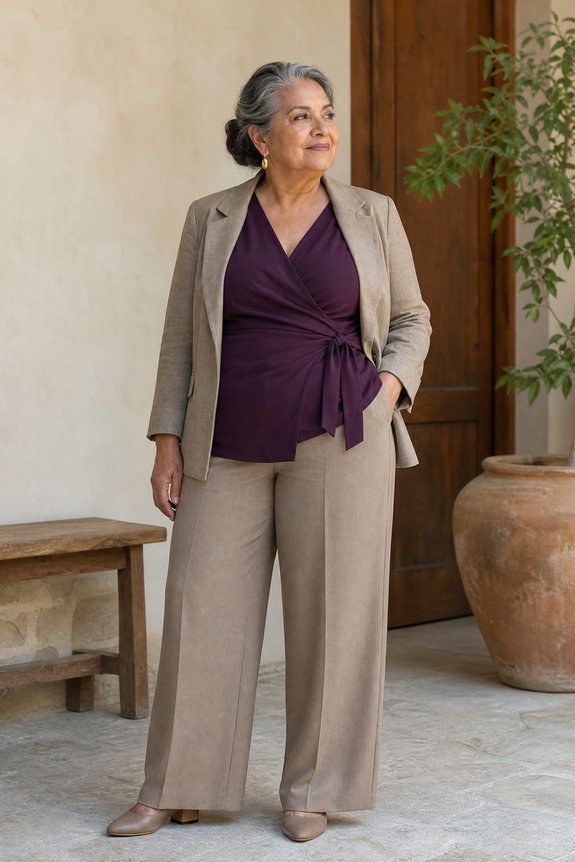
Your current measurements and preferences are more useful than the size you wore years ago. Bodies can change with age, but the changes are individual and do not justify a special set of restrictive fashion rules for every woman over 50.
Try on the outfit and identify the exact issue. Is the top ending at a place you do not like? Are both pieces stiff and oversized? Is the jacket catching at the hips? Are the trousers pooling over the shoes? Specific questions lead to specific fixes.
If your measurements are no longer current, record your bust, waist, hips, shoulder width, inseam, and preferred garment lengths. Use the product-specific chart when shopping because sizing and proportions vary between brands and styles.
Create Definition Without Tight Cinching
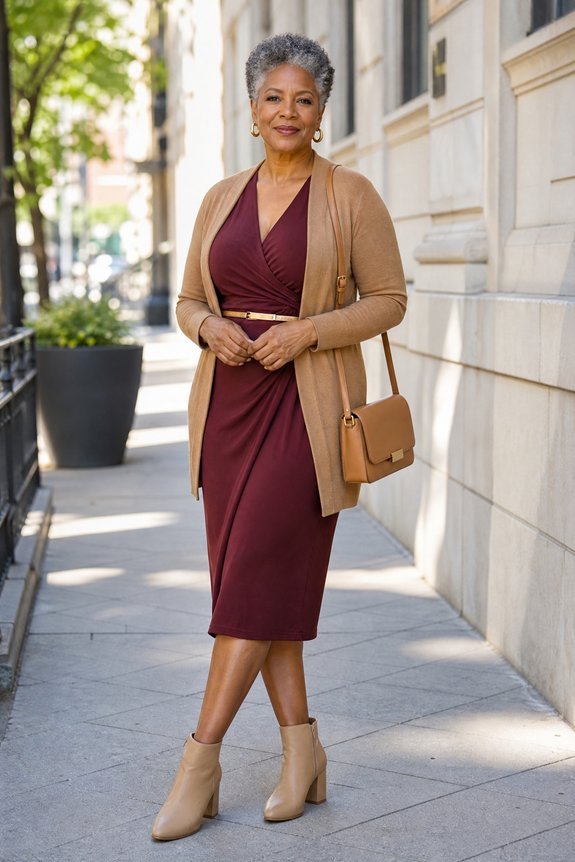
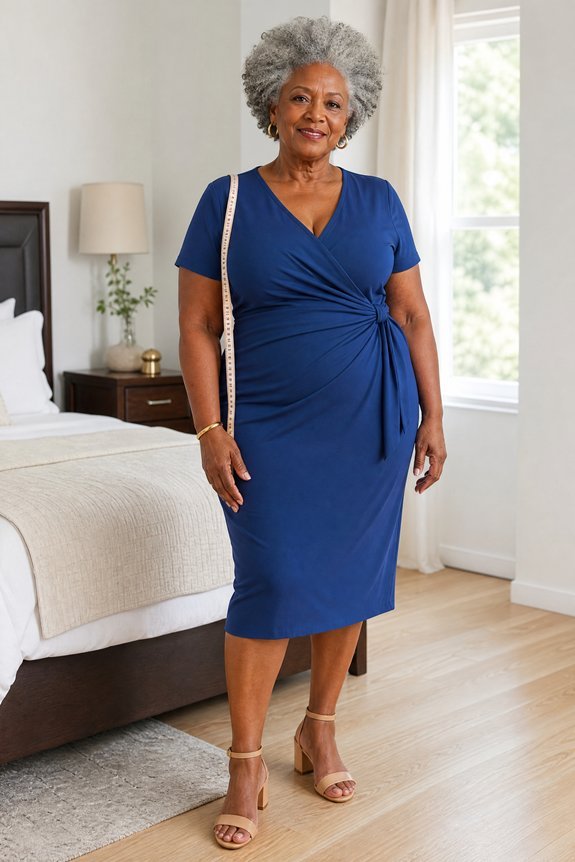
Waist definition does not require a tight belt. It simply means giving the outfit a visible change of direction or a point where the fabric comes closer to the body.
- Use a full or partial tuck to reveal part of the waistband.
- Choose a jacket with shaped seams or wear a straight jacket open over a simple top.
- Try a wrap top with enough bust room so the neckline stays flat.
- Use a self-tie belt loosely rather than pulling a rigid belt tight.
- Look for dresses with panel seams, gentle ruching, or a change in fabric direction.
The best location may be your natural waist, slightly above it, or lower on the torso. Move the point of definition until the garment sits comfortably and the outfit has the structure you want.
Balance Volume Without Making Everything Fitted
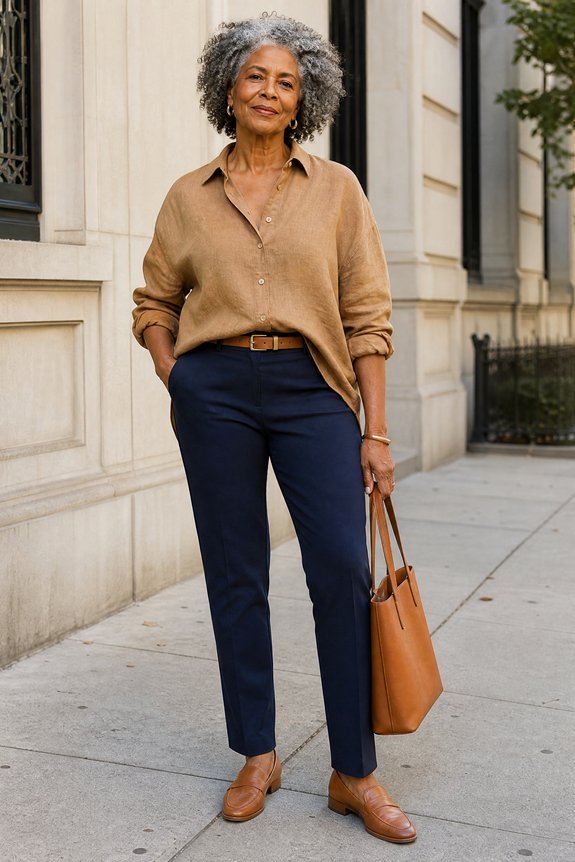
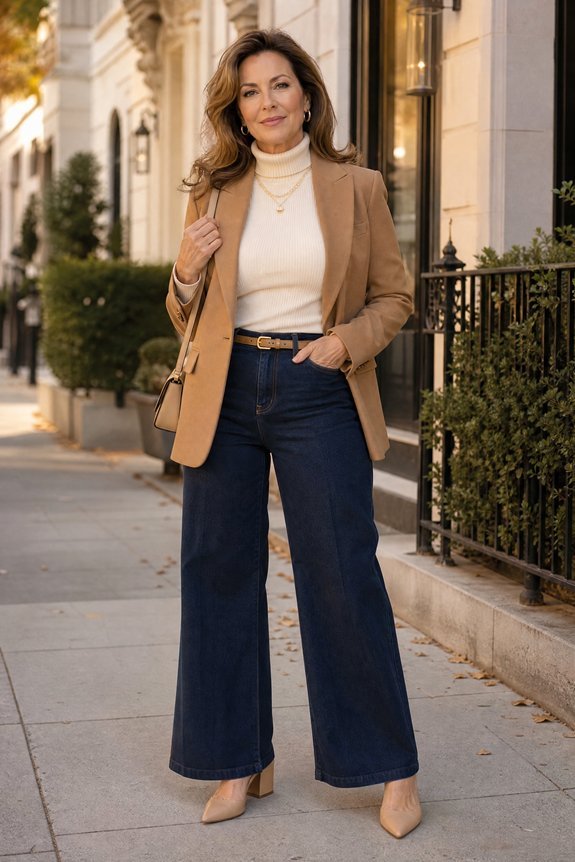
A simple starting point is to combine one roomy piece with one cleaner, less voluminous piece. Wide-leg trousers can work with a tucked knit, a shorter jacket, or a shirt that shows part of the waistband. An oversized blouse can work with straight trousers or a skirt that follows the body more closely.
However, loose-over-loose outfits can also look intentional. The key is controlling the fabric and the breaks. A fluid shirt over draped trousers behaves differently from a stiff boxy shirt over rigid wide-leg jeans. Showing a wrist, collarbone, waistband, or ankle can give an oversized outfit a clearer outline without making it tight.
For a practical example, these wide-leg-jeans outfits for women over 50 show how top length and waist placement change the balance of the same trouser shape.
Use Hemlines to Control the Visual Breaks
Every hem creates a line. That includes the bottom of a top, jacket, skirt, dress, trouser leg, and sleeve. When several strong hems finish at nearly the same level, an outfit can appear divided into heavy blocks.
Try changing one length:
- Shorten or tuck a long top so it does not compete with a wide trouser.
- Choose a jacket that ends clearly above or below the fullest part of the hip if you do not want the hem to emphasize that area.
- Adjust trouser hems for the shoes you actually wear instead of accepting excess pooling.
- Push or tailor sleeves to reveal the wrist and break up a large area of fabric.
There is no universally flattering mid-knee, ankle, or hip position. The ideal hem depends on the garment, your proportions, and how the remaining pieces complete the line.
Treat the Rule of Thirds as an Experiment
The styling “rule of thirds” suggests that uneven sections can look more dynamic than dividing an outfit exactly in half. You might create a shorter top section and a longer lower section with a tucked shirt and high-rise trousers, or reverse the relationship with a long coat.
You do not need to calculate a precise one-third/two-thirds ratio. Use the idea as a comparison: photograph the top untucked, partially tucked, and fully tucked. Then compare the visual breaks. A half-and-half outfit can still work beautifully when the color, fit, and silhouette are intentional.
Use Color and Layers to Create Longer Lines
Color can either connect or divide an outfit. Similar values from top to bottom create a more continuous column, even when the pieces are not identical. Strong contrast creates a clearer break and makes the placement of the waistband or hem more noticeable.
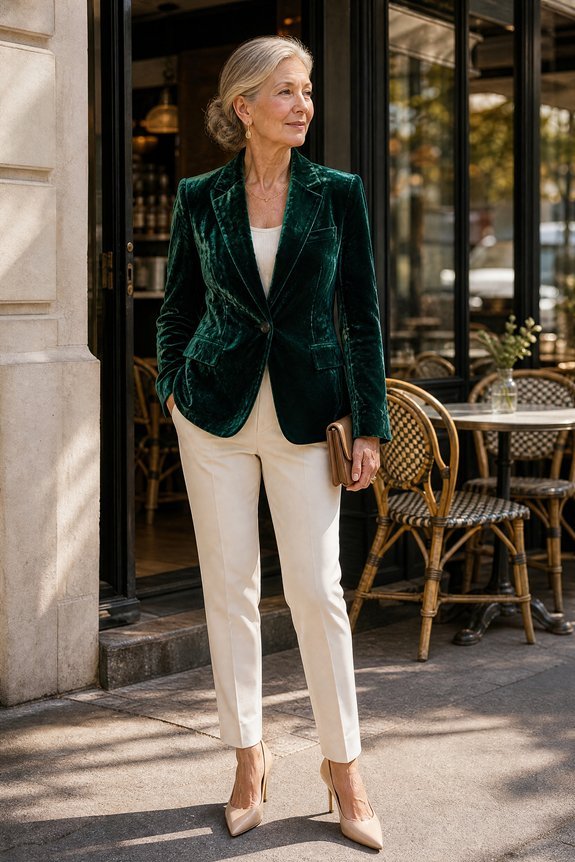
An open jacket, cardigan, or shirt adds two vertical edges over the inner outfit. This can organize the look without covering your body. The outer layer does not have to be dark; cream over camel, navy over blue, or burgundy over soft pink can create the same connected effect.
Vertical seams and pressed trouser creases can reinforce that direction, while pockets, belts, stripes, and contrasting hems add horizontal emphasis. Choose according to where you want the eye to travel rather than treating either direction as automatically slimming or flattering.
Tailor the Areas That Control the Garment
Small alterations can improve proportion because they help the garment hang from the correct place. Prioritize:
- Shoulders: A shoulder seam that sits too far out can make the entire upper body look drooped and may also make sleeves appear too long.
- Trouser hems: Correct length allows the intended leg shape to remain visible instead of collapsing over the shoe.
- Sleeves: Shortening an overly long sleeve can restore the intended balance of a jacket or blouse.
- Side seams and darts: These can add modest shaping when a garment fits in the bust or hips but contains too much fabric elsewhere.
Ask a tailor whether the alteration is sensible before buying the garment. Shoulders, armholes, heavily constructed jackets, and major size changes are generally more involved than simple hems or modest seam adjustments.
Five Outfit Formulas to Test
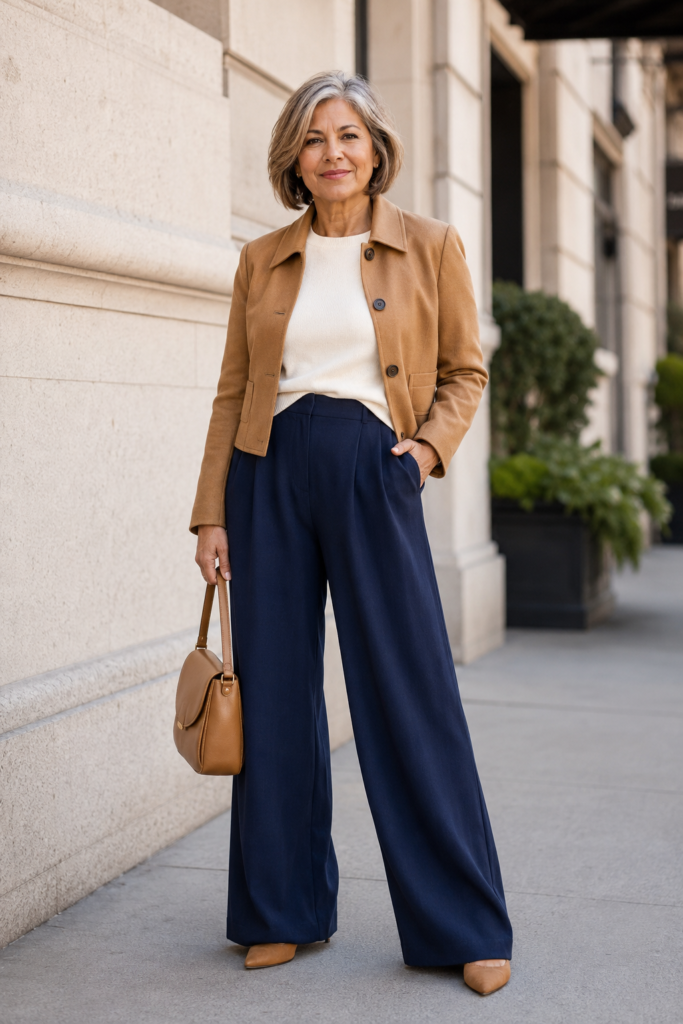
- Wide-leg trousers + tucked knit + short jacket: reveals the waistband and keeps the trouser shape visible.
- Straight jeans + untucked fluid blouse + open blazer: combines a relaxed middle layer with clean vertical outer edges.
- Column dress + waist- or hip-length jacket: adds structure without concealing the dress silhouette.
- Midi skirt + fitted tee + cardigan ending near the waist: keeps the skirt volume distinct from the upper layer.
- Monochromatic base + contrasting open longline layer: maintains a continuous inner column while adding movement and framing.
If you have a petite frame, the examples in these fall outfits for petite women over 50 provide more ways to compare garment volume and length without relying on oversized camouflage.
Use the Three-Photo Test
When an outfit feels wrong, take three photographs from the same position. In the first, wear it as planned. In the second, change the top or jacket length with a tuck, fold, or different layer. In the third, change the volume by opening the jacket, pushing the sleeves, or switching one garment.
Compare the photographs and ask:
- Can I see the shape or focal point I intended?
- Are several garments ending or widening at the same place?
- Does the outfit move comfortably when I sit and walk?
- Which version feels most like me?
This makes proportion practical. You are comparing visible results, not trying to diagnose your body or satisfy a mathematical formula.
Conclusion
Balanced proportions come from the relationship between your clothes: their lengths, volume, lines, and points of contrast. You can define your shape with a tuck, seam, open layer, correct hem, or simple tailoring without squeezing your waist or hiding beneath excess fabric.
Begin with one outfit and change one element at a time. Adjust the length, reduce or redirect the volume, or move the visual break. Keep the version that feels comfortable and looks intentional to you. That is a far more useful standard than dressing according to age or trying to make every body follow the same proportions.